What if I told you I could take you back through a historical period that flourished with innovation and shaped the way modern civilizations proceed today?
Renaissance hairstyles stand as one such time-travel machine which not only promises to make you look superior to the rest, but also grants you a ticket to a history of mankind.
Every hairstyle you may witness in this article carries a story behind it, a story that left behind confinements of rigid thinking and endorsed advancement & growth.
To bring you to the present day, I’ve received quite a few styling requests by my clients in the Renaissance trends.
I’ve had to upgrade myself to live up to the challenge, but it has opened my mind’s door to knowledge which I’m about to share with you in this article.
I hope you’ll bear with me patiently.
Table of Contents
- Timeless Concepts For Inspiring Beauty
- French Bob
- Wavy Highlighted Locks
- Viking Braids
- Braided Cornrow Ponytail
- French Braid Updo
- Braids & Waves
- Twists Overflow
- Curly Crown
- Half Flat Bang With Long Hair
- Three Buns With Plaits
- Folded Braid Wrapped In Ribbon
- Blonde Braid & Bun
- Two Lengthy Plaits
- Long & Wavy Ginger
- Blonde Middle Part
- Casual & Classic Fringe
- Tight Ponytail
- Artsy Two Tone Hair
- Advantages & Disadvantages Of Renaissance Hairstyles
- Thoughts
Renaissance Hairstyles: An Intriguing History
The Renaissance era began in the early 15th century with the fall of Constantinople. Little did anyone know how much it’d impact the course of history as well as every aspect of European culture.
The locals were exposed to tasteful art and culture that left them inspired in their personal lives. As being open to experimentation has been a core factor of this time period, new & alluring hairstyles found their way out at the hands of creative women.
Each of the Renaissance hairstyles bear the mark of that age, the people and their culture. Finding out their significance can take hours to explain, much like appreciating the beauty of each design.
From paintings to sculptures, all of the hairdos echo the cultural beauty and historical significance that’ll only attach more meaning to the one hairstyle you choose to obtain today.
Timeless Concepts For Inspiring Beauty
The following hairstyles are recognized as timeless concepts that demand to be tried out in the modern day. No matter what the context is, you’ll find a fitting hairdo for each occasion in my list!
French Bob

The French bob cut is probably the most classic hairstyles from the Renaissance era with a significant character drawn upon it. Such hairstyles have transcended past decades to reach the doorstep of mid 1950 until the modern designs had arrived!
From that span, you can probably make out how impactful it had been on the mass culture. The method of wearing this is simple, it requires a basic bob cut at the length where your hair gently kisses your neck. A bang up front to cover up the forehead completes the look!
Whether for regular use or for a Renaissance party, it still carries a significant bit of charm even in 2026! Paying close attention to the hairdo will make it apparent that I’m telling the truth!
Wavy Highlighted Locks
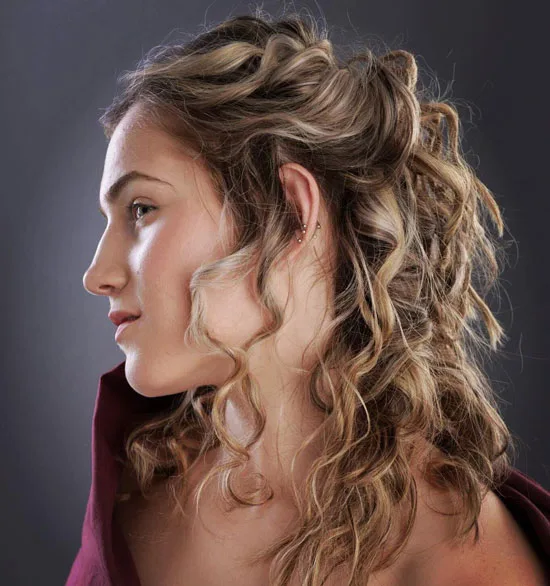
If alluring hairdos are your forte, these wavy locks with variable highlights will most certainly tempt you into getting for yourself. It has lasted well past the Victorian era as a symbol of posh & classy women with a prime bridal hairstyle choice at the current age.
You’ll be needing back length hair to begin with. A time-saving factor would be your naturally wavy hair, otherwise you may have to seek refuge in a hair curler. Bleach your hair in random order so that the two tones don’t stand out as neat, rather something a little messy.
Wrap the majority of your hair body at your nape into a small twisted tie and let it all loose in a sketchy, carefree manner. That’s the main charm of this look, if you ask me!
Viking Braids

The Viking trends are going through a revival at the moment, all thanks to those TV shows and movies paying homage to this culture and their artifacts. Viking braids in this case stand as an elegant concept brought forth from the time of Renaissance.
There must be an extensive application of bleach on the top layer so that the blonde tone is highlighted to the maximum. A healthy braid down the middle, one thin plait on either side and a couple of narrow braids created from the side hair render this look a gorgeous one!
Braided Cornrow Ponytail
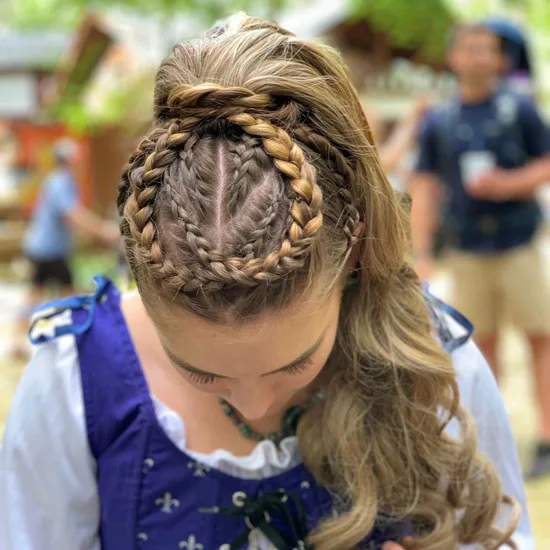
A lot of things are going on in this hairdo and for this reason, it’s quite demanding from a consumer’s end! You’ll need to be a master of cornrows converted into oval braids with different tones achieved through bleaching and dyeing. That’s why it produced an equally impactful effect!
The cornrows with braids sitting on top are to be made in layers. Bottom layer here should consist of the original hair color with thinner braids while the top layer of blonde tone endorses thicker ones. Tie them all together at your nape and let out the untangled hair flow free.
French Braid Updo

French braids have been a captivating aspect of European hairstyles, especially the ones that formed during the Renaissance era. Even back then, these styles would be experimented with and worn in an inverse direction, much like the updo braid that I’m showing you right now.
At either side of your head, you must consume all of the fringes into two French braids. That is of essence as the edges are to display how neatly they contributed to each healthy braid. Then, pull them over your head like a crown and attach them together to complete the design!
Braids & Waves

Although it’s drawn from the books of Renaissance, this has ideally been utilized as a wedding hairstyle for the past couple of decades. A basic middle part with only the front hair lets a few curly locks loose. At the back, one large layer of hair is laid down with a plait covering the crown area. Rest of the braids remain across the nape and blonde loose curls slide down till the end.
Twists Overflow

Why not settle for twists all over your head instead of siding with braids or plaits? It’s much easier to do, doesn’t require you to learn braiding and carries a marvelous effect too! The frontal area of your head is to be combed back until the nape. There, you’ll twist your hair into rings fastened by bands. Repeat this process all the way to generate a bubble hairstyle!
Curly Crown
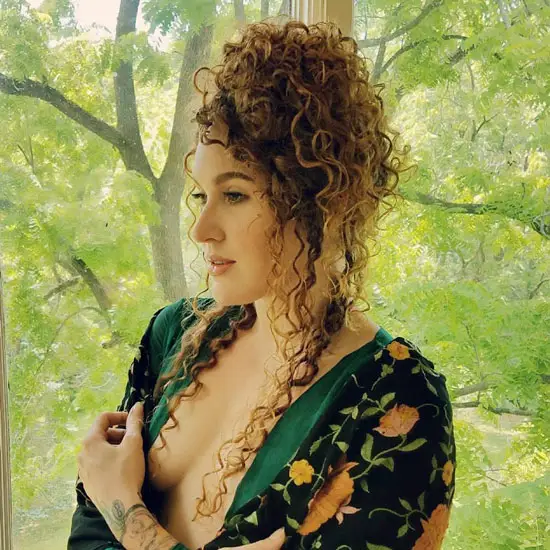
Use your natural curls to your advantage! Dye them into a different tone than the one you originally have to create variation among your locks. Then, wrap them around over your crown and tie them with a hair band. Let the hair body overflow to cover up the tie with a few loose strands gorgeously slide over the edges.
Half Flat Bang With Long Hair
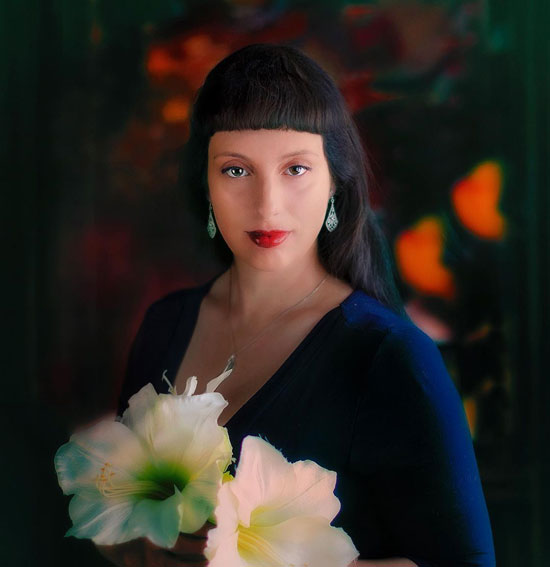
It’s a very neat and basic hairstyle that often attracts the minimalists. Such styles have been mimicked even in films due to the potential it has to offer. A half, flat bang residing over the forehead with dark hair sliding down the back is the most convenient way you can apply this hairstyle. Sharpen up the bang to boost up the effect instantly!
Three Buns With Plaits
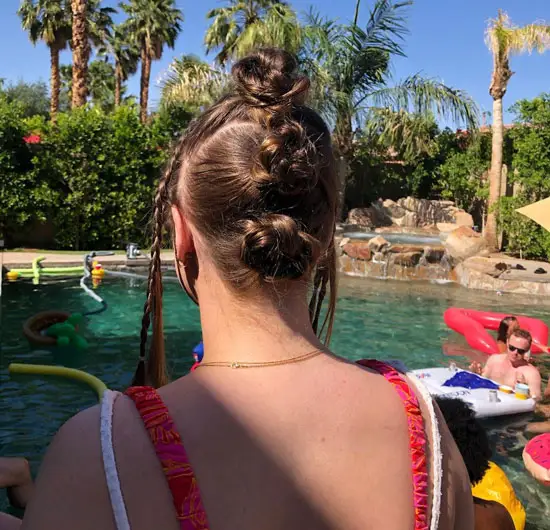
While most of the Renaissance hairstyles may seem quite demanding in terms of upkeep, this one in particular is a low-maintenance design. Divide your hair into four sections as you move toward your nape and create two thin plaits on each side at the front. The rest of each section will consume all the hair in that area to make into tight buns!
Folded Braid Wrapped In Ribbon

An ancient hairstyle that was granted prominence much later than its inception is this folded braid and ribbons. During the Elizabethan period, it was one of the most common signs of an upper-class lady. Braids generating from two ends are merged together while being fed by a vibrant ribbon and folded upward as a final touch. Pearled ribbon would be an added bonus.
Blonde Braid & Bun

This is another complex-looking, strikingly outrageous hairstyle that isn’t straightforward to attain. A foundation that draws nape hair into a bun, two-tones are a key aspect that highlight it much like the braids. Tight plait is to be wrapped around the bun while on the other hand, frontal hair is drawn at the back in waves. These are finally set loose over the neck.
Two Lengthy Plaits
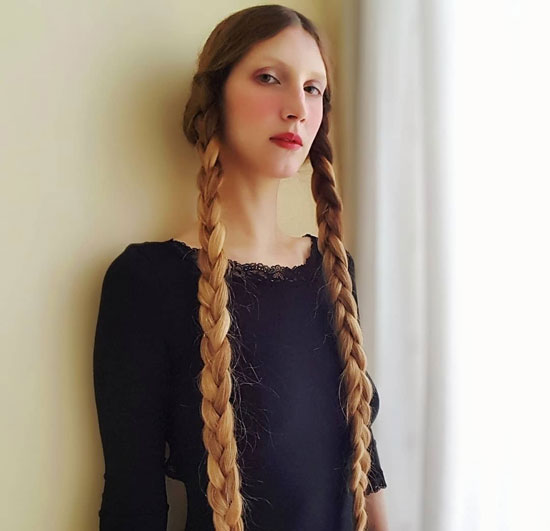
Ones with hip length hair can easily endorse this Renaissance hairstyle without complicating the situation. Simply part your hair down the middle and take each side for a considerable braid starting from your nape. Upon reaching the end, put on a hair band and leave a couple of inches loose on the other side of it.
Long & Wavy Ginger

Another great news for beauties carrying gorgeously long ginger hair! You’ll be the most convincing winner should your hair be wavy, otherwise you need to go through a simple curling process to draw out those fabulous waves! Part your hair down the middle and let it all slide down like a soothing, fiery waterfall!
Blonde Middle Part

Imagine you’re being asked to recall a Renaissance portrait. You’ll notice this hairstyle in particular is nothing shy of a painting, and getting it done is so easy that you’ll be able to manage it right now if you’re blonde! Otherwise just bleach your hair, comb down the middle and wear a chain across your forehead – and done!
Casual & Classic Fringe

It’s one of those Bryce Dallas Howard interpretations of classic hairstyles enhanced with a couple of colors like pink, caramel or golden. Firmly combed bangs with a sharp fringe right over the eye sets the mood for the concept. The rest is a simple middle part with messy, casual hair ends.
Tight Ponytail

Did you know that a basic ponytail has always been a part of the classic Renaissance hairstyles? Only difference between that and the modern concept is, the older version carried the nape hair quite loosely with all the tightness resting on top. This vintage look will sketch a Shakespearean character out of you!
Artsy Two Tone Hair
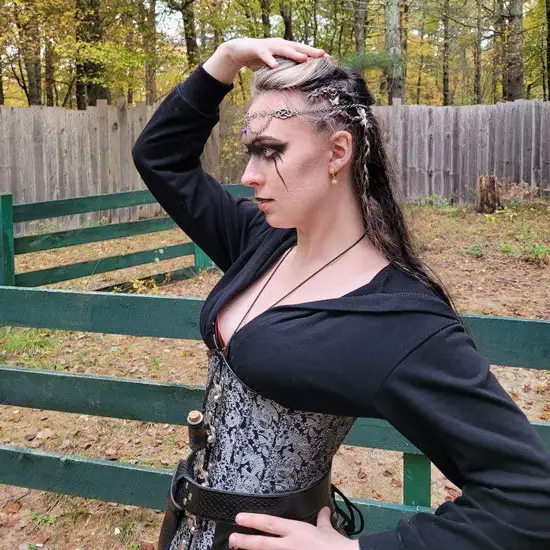
The last concept in my list is quite a daring one as it complies with gothic aesthetics to some extent. Top part of the hair bleached & coiled on the crown as the nape hair reaches down gently. A couple of thin braids on either side with a ferronnière on the forehead to sum up the style!
Advantages & Disadvantages Of Renaissance Hairstyles
With such unique hairstyles where one’s completely authentic to the very next, there are certain positive aspects as well as downside that you must understand. This will help you decide whether you want to walk down such a path of eccentric hairdos.
Advantages
Let’s look at the good things first, it’ll definitely cheer you up!
- Elegant Concepts: Such delicacy in hairstyle is rarely found in the modern day, that’s one of the many charms of Renaissance hairstyles. You’ll be turned into a classy woman after getting through the styling process.
- Ideal Wedding Makeover: If you’re looking for exclusive hairstyles to be the prettiest bride anyone has ever seen, this is the category to pose you as the winner!
- Can Be Achieved Using Natural Measures: As chemicals weren’t part of Renaissance styling in the fashion that we do now, there are many natural ways you can be a part of this group. While these may be a little challenging to follow through, your hair’s health is ensured in the end.
I personally think Renaissance designs carry hefty potential for people of all ages. Of course, it’s a matter of preference in the end.
Disadvantages
Every good thing contains some negatives as well. Addressing them at the earliest should tell you precisely what you’re getting into.
- Can Be Expensive: Not all of the designs in this genre can be done by yourself. Some require professional interventions, and being a salon-owner myself, I can affirm that these don’t come in cheap.
- Difficult To Maintain: If you’re going for a conceptual overflow bearing multiple designs, it’ll be quite challenging for you to maintain them over a prolonged duration. Not all of the Renaissance hairstyles are like this though, but the hurdle remains there.
So, commit to the design that caters to your desires as well as capabilities the most. This way, you’ll be able to enjoy these awe-inspiring hairstyles to the fullest!
Thoughts
We’ve now reached the end of a wonderful journey through time as well as timeless culture.
I reckon Renaissance hairstyles are mostly trending these days for their attractive features and not so much for their historical values.
Don’t get me wrong, I’m not suggesting that visiting a Renaissance fair dressed as a classic European milkmaid takes anything away from the significance.
Rather I’m merely hinting at the potential meanings you could attach to your makeover only if you found curiosity enough to learn about the styles while placing them in the context.
If I should speak from a stylist’s point of view, I’d say bringing back the Renaissance hairstyles won’t necessarily be a practical approach.
But every once in a while, paying a tribute to that time can help us improve the way we perceive things and make meaning out of concepts we take for granted.
Until we read again, peace.